


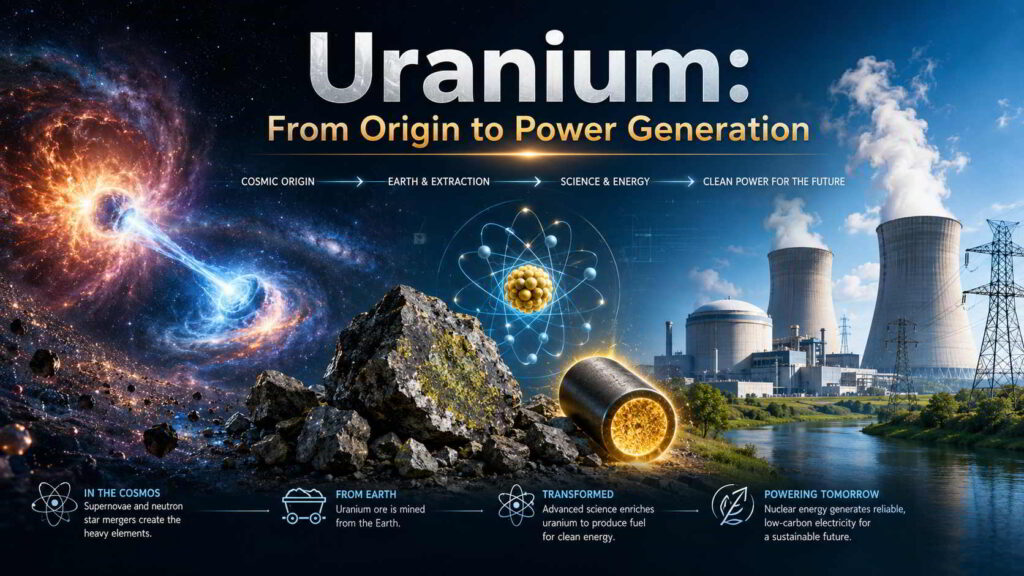
Uranium Explained: From Cosmic Origin to Nuclear Power Generation
Uranium is one of the most powerful and mysterious elements found on Earth. It is not only a metal hidden inside rocks; it is also a source of massive energy, a key fuel for nuclear power generation, and an important part of global energy security. When we talk about uranium, we are actually talking about science, space, geology, mining, nuclear physics, electricity generation, climate change, geopolitics, and the future of clean energy.
The story of uranium does not begin in a mine. It begins in space. Long before human civilization, long before Earth was formed, uranium atoms were created in extremely powerful cosmic events. Today, uranium is mined from Earth, processed into nuclear fuel, placed inside nuclear reactors, and used to generate electricity for cities, industries, hospitals, railways, data centers, and modern economies.
In this article, we will understand the complete journey of uranium: from its cosmic origin to nuclear power generation. We will also explore uranium mining, uranium enrichment, nuclear fuel cycle, nuclear waste management, uranium reserves by country, top uranium producing countries, India’s nuclear energy future, and why uranium has become a trending topic in the global clean energy debate.
What Is Uranium?
Uranium is a naturally occurring radioactive chemical element with the symbol U and atomic number 92. It belongs to a group of elements known as actinides. Uranium is found in small amounts in rocks, soil, water, and even in trace quantities in plants and seawater. However, only some geological locations contain uranium in enough concentration to be mined economically.
Natural uranium mainly contains three isotopes: uranium-238, uranium-235, and uranium-234. Uranium-238 is the most abundant isotope, while uranium-235 is present in a much smaller amount. But uranium-235 is extremely important because it can sustain a nuclear chain reaction, making it useful for nuclear power generation. Natural uranium contains about 0.7% uranium-235, while most of the rest is uranium-238.
Reference: https://www.iaea.org/newscenter/news/what-is-uranium
The Cosmic Origin of Uranium
How Was Uranium Created in the Universe?
Uranium is not an ordinary element created by simple chemical reactions. It is a heavy element, and heavy elements are formed under extreme cosmic conditions. Scientists believe that many heavy elements, including uranium, were created through processes such as supernova explosions and neutron star mergers. These events involve huge energy, extreme pressure, and rapid neutron capture.
In simple words, uranium is a product of cosmic violence. When massive stars explode or when neutron stars collide, atomic nuclei can capture neutrons rapidly and form heavy elements. Later, these elements spread into space through cosmic dust and gas. Over billions of years, this material became part of new stars, planets, asteroids, and eventually Earth.
How Did Uranium Reach Earth?
Earth formed around 4.6 billion years ago from a cloud of gas, dust, and rocky material. Uranium atoms were already present in that material. As Earth cooled and geological processes continued, uranium became distributed in rocks and minerals. In some places, natural processes concentrated uranium into deposits that are now mined.
This means every uranium atom found today carries a history older than Earth itself. When a nuclear power plant uses uranium fuel, it is indirectly using energy stored in matter formed by ancient cosmic events.
Where Is Uranium Found on Earth?
Uranium is found in many types of rocks, but economic deposits are limited. It can occur in sandstone deposits, unconformity-related deposits, volcanic deposits, phosphate deposits, and other geological formations. Some countries have large uranium resources, while some countries produce more uranium because they have active mines and better mining infrastructure.
It is important to understand the difference between uranium resources and uranium production. Uranium resources mean estimated uranium available underground that may be economically recoverable. Uranium production means the actual uranium mined in a particular year.
Top Uranium Producing Countries
Uranium production is concentrated in a small number of countries. According to World Nuclear Association data, Kazakhstan was the largest uranium producer in 2024, producing about 39% of global mine supply. Canada produced about 24%, and Namibia produced about 12%. Together, Kazakhstan, Canada, and Namibia produced nearly three-quarters of the world’s mined uranium in 2024.
Why Kazakhstan Is Important in Uranium Supply
Kazakhstan has become the world leader in uranium mining mainly because of its large uranium deposits and extensive use of in-situ leach mining. In-situ leach mining allows uranium to be extracted without traditional deep mining in certain geological conditions. This method has become very important in global uranium production.
Why Canada and Namibia Matter
Canada is known for high-grade uranium deposits, especially in Saskatchewan. Namibia has also become one of the most important uranium-producing countries because of its large mines and rising role in nuclear fuel supply chains. As nuclear energy demand grows, countries with stable uranium production are becoming strategically important.
Uranium Mining: How Uranium Comes Out of the Ground
Uranium mining is the first major step in the nuclear fuel cycle. There are three main methods of uranium mining.
Open-Pit Mining
Open-pit mining is used when uranium ore is close to the surface. Large amounts of soil and rock are removed to access uranium-bearing ore. This method is similar to mining used for many other minerals.
Underground Mining
Underground mining is used when uranium deposits are located deep below the surface. Tunnels and shafts are created to reach the ore body. This method requires strong safety systems, ventilation, and radiation monitoring.
In-Situ Leach Mining
In-situ leach mining, also called in-situ recovery, involves pumping a solution underground to dissolve uranium from porous rock. The uranium-rich solution is then pumped back to the surface for processing. More than half of global uranium mine production now comes from in-situ leach methods.
From Uranium Ore to Yellowcake
After mining, uranium ore is processed in a mill. The ore is crushed and treated chemically to separate uranium from waste rock. The final product is uranium oxide concentrate, commonly called yellowcake. Despite the name, yellowcake is not always bright yellow. It can be dark green, brown, or black depending on its chemical composition.
Yellowcake is not yet ready for use in a nuclear reactor. It is only an intermediate product. It must go through conversion, enrichment, and fuel fabrication before becoming nuclear fuel.
The Nuclear Fuel Cycle
The nuclear fuel cycle is the complete process through which uranium becomes reactor fuel and later becomes spent fuel. The main steps are mining, milling, conversion, enrichment, fuel fabrication, reactor use, and spent fuel management.
Mining
Uranium ore is extracted from the Earth.
Milling
Ore is processed into uranium oxide concentrate, known as yellowcake.
Conversion
Yellowcake is converted into uranium hexafluoride, or UF6. This form is useful because it can be turned into gas for enrichment.
Enrichment
The concentration of uranium-235 is increased. Natural uranium contains only about 0.7% uranium-235, but many commercial light-water reactors use fuel enriched to around 3% to 5% uranium-235.
Fuel Fabrication
Enriched uranium is converted into ceramic pellets. These pellets are stacked inside metal tubes called fuel rods. Fuel rods are grouped into fuel assemblies.
Reactor Use
Fuel assemblies are loaded into a nuclear reactor, where uranium atoms undergo fission and release heat.
Spent Fuel Management
After use, spent nuclear fuel is removed from the reactor and stored safely. Some countries reprocess spent fuel, while others store it for long-term disposal.
What Is Uranium Enrichment?
Uranium enrichment is one of the most important and sensitive steps in the nuclear fuel cycle. Natural uranium has too little uranium-235 for many modern nuclear reactors. Enrichment increases the percentage of uranium-235 so the fuel can sustain an efficient chain reaction.
Most commercial nuclear power reactors use low-enriched uranium. This is very different from highly enriched uranium used for non-civilian purposes. Because enrichment technology can have both peaceful and dangerous uses, it is monitored internationally through nuclear safeguards and agreements.
How Does Uranium Generate Electricity?
The Basic Principle: Nuclear Fission
Nuclear power generation is based on fission. Fission means splitting a heavy atomic nucleus into smaller parts. When a uranium-235 atom absorbs a neutron, it can become unstable and split. This splitting releases heat, radiation, and more neutrons.
Those extra neutrons can hit other uranium-235 atoms and cause more fission reactions. This creates a chain reaction. In a nuclear reactor, this chain reaction is controlled carefully.
How a Nuclear Reactor Works
Inside a nuclear reactor, fuel rods are placed in the reactor core. A coolant, often water, removes heat from the core. In many reactor designs, water also acts as a moderator, slowing down neutrons so the chain reaction can continue efficiently.
Control rods are used to manage the reaction. These rods absorb neutrons. When control rods are inserted deeper into the reactor core, the reaction slows down. When they are withdrawn, the reaction increases. The heat created by fission turns water into steam, and that steam spins a turbine to produce electricity.
Reference: https://www.energy.gov/ne/articles/nuclear-101-how-does-nuclear-reactor-work
Simple Explanation
A nuclear power plant works like a very advanced steam engine. The main difference is the source of heat. In a coal power plant, coal is burned to produce heat. In a nuclear power plant, uranium atoms split to produce heat. The heat makes steam, the steam turns a turbine, and the turbine runs a generator that produces electricity.
Why Nuclear Energy Is Called Low-Carbon Energy
Nuclear power plants do not burn coal, oil, or natural gas during operation. That means they produce electricity with very low direct carbon dioxide emissions. This is why nuclear energy is often discussed as a low-carbon electricity source.
According to the World Nuclear Association, nuclear energy provides about 9% of the world’s electricity from around 440 power reactors in 31 countries. It also provides a major share of the world’s low-carbon electricity.
The International Energy Agency has also described nuclear power as an established large-scale low-emissions energy source that can support secure energy transitions and help decarbonize electricity supply.
Reference: https://www.iea.org/reports/nuclear-power-and-secure-energy-transitions/executive-summary
Why Uranium Is Trending Again
Uranium is again becoming a global discussion topic because of rising electricity demand, climate change, energy security concerns, and the growing interest in small modular reactors.
Rising Electricity Demand
The world is using more electricity than ever before. Electric vehicles, data centers, artificial intelligence, cooling systems, industrial growth, and digital infrastructure are increasing electricity demand.
Climate Change and Clean Energy
Countries are trying to reduce carbon emissions. Solar and wind power are growing, but they depend on weather conditions. Nuclear power can provide stable electricity day and night.
Energy Security
After global energy shocks and geopolitical tensions, many countries want reliable domestic or diversified energy sources. Uranium supply chains are now part of energy security discussions.
Small Modular Reactors
Small Modular Reactors, or SMRs, are a trending topic in the nuclear industry. These reactors are designed to be smaller, factory-built, and potentially faster to deploy than traditional large reactors. Some advanced reactor designs may require special types of nuclear fuel, which is increasing interest in uranium supply and enrichment capacity.
Uranium and Geopolitics
Uranium is not just an energy resource. It is also a geopolitical resource. A country may have uranium ore, but it may still depend on other countries for conversion, enrichment, fuel fabrication, reactor design, or technology support.
This makes the nuclear fuel supply chain strategically important. Countries that control uranium mining, enrichment technology, nuclear reactor design, and fuel supply can gain influence in global energy markets.
For example, Kazakhstan leads uranium mine production, Canada has high-grade deposits, Australia has large uranium resources, and countries such as Russia, China, France, and the United States play important roles in different parts of the nuclear fuel cycle.
Uranium Resources vs Uranium Production
Many people confuse uranium resources with uranium production. A country with large resources may not always be the largest producer. Australia, for example, has very large identified uranium resources, but Kazakhstan is the largest producer.
World Nuclear Association data shows that known uranium resources have increased over the last decade because of exploration and resource development. Uranium is relatively common in nature, but only certain deposits are economically useful.
Reference: https://world-nuclear.org/information-library/nuclear-fuel-cycle/uranium-resources/supply-of-uranium
Nuclear Waste: The Most Sensitive Part of Nuclear Energy
Nuclear waste is one of the most discussed concerns related to uranium and nuclear power. Radioactive waste is generated during nuclear power plant operation, fuel processing, research, medicine, and decommissioning activities.
Spent nuclear fuel is highly radioactive and must be managed carefully. It is usually stored first in water pools and later may be moved to dry cask storage. Some countries reprocess spent fuel to recover usable materials, while others follow a once-through cycle.
The IAEA explains that radioactive waste must be managed in a way that keeps people and the environment safe over long periods of time.
Reference: https://www.iaea.org/topics/radioactive-waste-and-spent-fuel-management
Is Nuclear Power Safe?
Nuclear power safety depends on design, regulation, training, emergency preparedness, transparency, and safety culture. Modern nuclear power plants use multiple safety barriers. These include fuel pellets, fuel cladding, reactor vessel, cooling systems, containment structures, and emergency systems.
However, nuclear energy also requires public trust. Past accidents such as Chernobyl and Fukushima shaped public opinion. Today, nuclear safety regulations are much stricter, and new reactor designs include improved safety features. Still, no energy source is completely risk-free.
Coal has air pollution and carbon emissions. Hydropower can affect rivers and ecosystems. Solar and wind need land, minerals, storage, and grid support. Nuclear power requires radiation safety, waste management, and strong governance. The real question is not whether nuclear power is perfect. The real question is how responsibly it can be used.
India’s Nuclear Energy Future
India’s nuclear energy programme is very important for the country’s long-term energy security. India needs massive electricity supply for economic growth, urbanization, industry, railways, digital infrastructure, and clean energy transition.
According to official information from the Government of India, India’s installed nuclear power capacity has increased to 8,780 MW and is projected to reach 22,380 MW by 2031–32. India has also announced a long-term target of 100 GW nuclear power capacity by 2047.
Reference: https://pib.gov.in
Why Nuclear Power Matters for India
India is one of the world’s fastest-growing major economies. Its electricity demand will continue to rise. Solar and wind power are important, but they need storage and grid balancing. Coal still provides a large share of India’s electricity, but it creates pollution and carbon emissions.
- Nuclear power can help India in four major ways.
- First, it can provide stable baseload electricity.
- Second, it can reduce dependence on imported fossil fuels.
- Third, it can support low-carbon energy goals.
- Fourth, it can strengthen India’s scientific and strategic capability.
India’s Three-Stage Nuclear Programme
India’s nuclear programme has traditionally followed a three-stage approach. The first stage uses natural uranium in pressurized heavy water reactors. The second stage uses plutonium in fast breeder reactors. The third stage aims to use thorium, which is important because India has significant thorium potential.
This makes India’s nuclear journey different from many other countries. For India, uranium is important today, but thorium may become important for long-term nuclear energy security.
Uranium, AI Data Centers, and Future Energy Demand
One reason nuclear power is getting fresh attention is the rapid rise of AI data centers. Artificial intelligence, cloud computing, cryptocurrency infrastructure, and digital platforms require huge amounts of continuous electricity. Solar and wind are clean but variable. Nuclear power is attractive because it can generate large-scale electricity continuously.
This is why nuclear energy, small modular reactors, uranium supply, and nuclear fuel security are becoming trending topics in discussions around AI infrastructure and future electricity demand.
Advantages of Uranium-Based Nuclear Power
High Energy Density
Uranium has extremely high energy density. A small amount of nuclear fuel can produce a huge amount of electricity compared to fossil fuels.
Low Operational Carbon Emissions
Nuclear power plants produce very low direct carbon emissions during operation.
Stable Power Supply
Unlike solar and wind, nuclear power can generate electricity continuously, day and night.
Energy Security
For countries with nuclear capability, nuclear power can reduce dependence on imported fossil fuels.
Challenges of Uranium-Based Nuclear Power
High Initial Cost
Nuclear power plants require high capital investment and long construction timelines.
Waste Management
Spent nuclear fuel requires careful long-term management.
Safety and Public Trust
Nuclear accidents are rare but can have serious consequences. Strong safety culture is essential.
Fuel Supply Chain
Mining, conversion, enrichment, and fuel fabrication depend on complex global supply chains.
Fact-Check Summary
Important Verified Facts
Natural uranium contains about 0.7% uranium-235, while most of it is uranium-238.
Most commercial light-water reactors use enriched uranium with around 3% to 5% uranium-235.
Kazakhstan was the largest uranium producer in 2024, followed by Canada and Namibia.
Nuclear energy provides around 9% of global electricity.
India’s nuclear power capacity is projected to rise significantly by 2031–32, with a long-term target of 100 GW by 2047.
Conclusion: Uranium’s Journey from Stars to Electricity
Uranium’s journey is one of the most extraordinary stories in science. It begins in cosmic events, becomes part of Earth’s rocks, is mined from selected deposits, processed into yellowcake, converted and enriched, shaped into nuclear fuel, placed inside reactors, and finally used to generate electricity.
But uranium is not only a scientific material. It is also a symbol of responsibility. The same element that can power cities must be managed with safety, transparency, and international safeguards. Nuclear energy can support clean electricity, energy security, and industrial growth, but it also requires strong regulation, waste management, and public trust.
As the world faces climate change, rising electricity demand, AI data center growth, and energy security challenges, uranium and nuclear power are again becoming part of the global energy conversation. For India, uranium is not just a mineral. It is connected to energy independence, clean power, scientific progress, and the vision of a developed India by 2047.
From stars to stones, from mines to reactors, and from atoms to electricity, uranium tells us one simple truth: the future of energy will not depend on one source alone. It will depend on balance, science, responsibility, and smart choices.
Watch Related Video
For a simple Hindi explanation of this topic, watch this related video from Steno India | Exams & Career:
How did uranium originate? It creates electricity and destroys cities | Uranium Explained in Hindi
Watch on YouTube:
